Walk into any pharmacy and you’ll find an entire aisle of vitamins. Hundreds of bottles, impressive-sounding doses. But approximately 98–99% of the vitamins in those aisles are synthetic isolates — manufactured in a laboratory, not derived from food.
That single fact changes everything about how your body responds to them.
As a practitioner, one of the most common questions I hear from new clients is: “I already take a multivitamin — why don’t I feel any different?” The answer, more often than not, comes down to this distinction. Let’s break it down clearly.
What Are Synthetic Vitamins?
Synthetic vitamins are chemically isolated nutrients produced through industrial processes. They’re designed to mimic the molecular structure of vitamins found in food — but the keyword there is mimic.
The manufacturing inputs might surprise you:
- Vitamin B1 — derived from coal tar
- Ascorbic acid (marketed as “Vitamin C”) — corn syrup + sulfuric acid
- Synthetic Vitamin E — petroleum byproducts
- Many B vitamins — petrochemical derivatives
These isolated compounds may appear chemically similar to their natural counterparts, but they exist in isolation — stripped of the cofactors, enzymes, bioflavonoids, and trace compounds that naturally surround vitamins in real food. And that matters enormously for what happens next.
What Are Whole Food Vitamins?
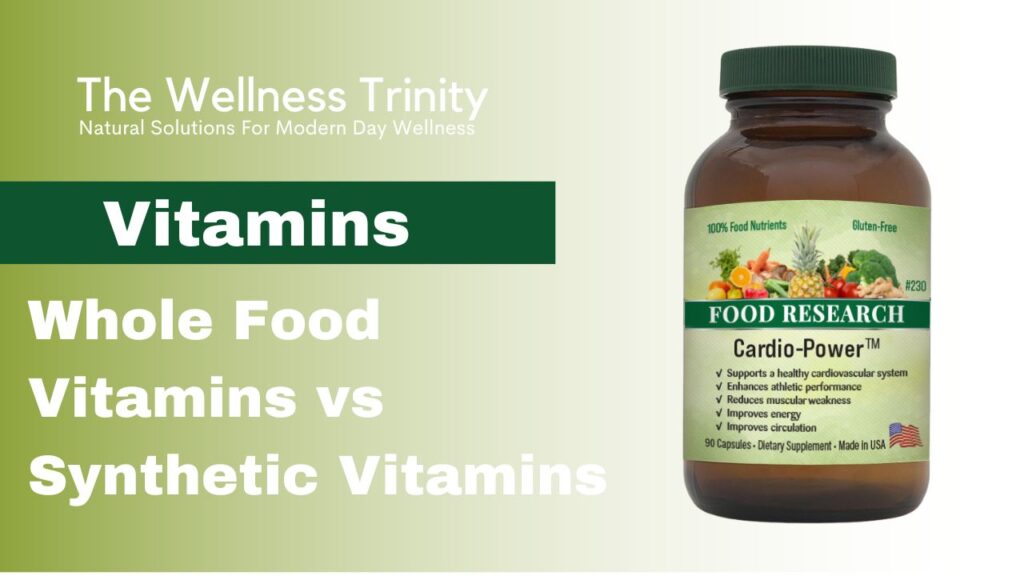
Whole food vitamins are exactly what they sound like: nutrients derived from concentrated, minimally processed foods. Rather than synthesizing a single isolated compound, whole food supplements preserve the full nutritional matrix — the vitamins alongside the enzymes, amino acids, lipids, and cofactors that nature packages them with.
An orange doesn’t just contain ascorbic acid. It contains Vitamin C as part of a complex with bioflavonoids, copper, antioxidant enzymes, and other compounds your body uses together. Isolate just the ascorbic acid, and you get a fragment of that picture.
Whole food Vitamin C, sourced from acerola cherries or similar foods, delivers the more complete picture — the one your body evolved to recognize and use.
| Factor | Synthetic Vitamins | Whole Food Vitamins |
|---|---|---|
| Source | Laboratory / industrial process | Concentrated whole foods |
| Cofactors | Stripped away — isolated nutrient only | Naturally present — enzymes, amino acids, bioflavonoids |
| Fillers & binders | Often contain magnesium stearate, titanium dioxide, and artificial colors | Food Research uses only purified water as a binder |
| GMO / Pesticides | Varies by manufacturer | None detected in Food Research products |
| How does the gut process it | As a foreign chemical compound | The same way it processes food |
Why Bioavailability Is the Real Question
“Bioavailability” means the proportion of a nutrient that actually enters your circulation and becomes available for your body to use. A supplement can contain 500mg of a vitamin and deliver very little — or contain 50mg and deliver far more effectively. Source matters enormously here.
Your gut also plays a critical role. Your digestive system evolved to recognize and process nutrients embedded in a food matrix. When you take a whole food supplement, your gut processes it similarly to actual food — activating the same digestive pathways, enzyme responses, and transport mechanisms. Synthetic isolates don’t always trigger those same responses.
The Problem with Fillers, Binders & Hidden Additives
Beyond the vitamin source itself, most synthetic supplements are laden with manufacturing additives: flow agents, binders, and fillers that help the pill hold its shape or the powder move through equipment.
For people with multiple sensitivities — a significant portion of the wellness-focused community — these additives trigger reactions that have nothing to do with the actual vitamin. Many of our customers couldn’t tolerate any supplement until they switched to Food Research products.
- No magnesium stearate (a common complaint trigger in sensitive individuals)
- No titanium dioxide, artificial colors, or synthetic preservatives
- No GMOs — none detected in any batch testing
- No isolated USP vitamins or industrial mineral salts
- The only binder used in tablets: purified water
- Capsule filler (where needed): organic brown rice or rice bran — strictly vegan
How Food Research Supplements Are Made Differently
This is where Food Research International stands apart from virtually every other supplement company — and why I chose to carry their products at The Wellness Trinity Store.
Food Research uses a proprietary process called cold fusion-hydroponic farming. Here’s what that means:
Specific nutrients are cultivated through living plants in a hydroponic environment, so they become part of a genuine whole food matrix — not blended in after the fact, but grown as food.
The entire process runs at low temperatures specifically to preserve naturally occurring enzymes and beneficial compounds. Heat destroys these; cold preserves them.
This farming method eliminates pesticide exposure entirely. Plants are used exactly as harvested from their controlled growing environment.
Every batch is tested using high-performance liquid chromatography (HPLC). Nutrient content is verified for potency — not assumed from the formula.
The result: a supplement where the nutrient is the food. Not a synthetic isolate added to a powder. This is what “100% food supplement” actually means — and it’s a standard almost no other company on the market meets.
What This Means for Your Health
If you’ve been taking a multivitamin for years and wondering why you don’t feel a measurable difference, this is likely why. Your body is receiving fragments of nutrients it can’t fully recognize — and simultaneously working to process additives that don’t belong there.
Switching to whole food supplements doesn’t produce an overnight transformation. These are real food nutrients, and they work the way food works — gradually, cumulatively, building nutritional reserves your body can actually draw from. Most people begin to notice a difference within 4–8 weeks: better energy, improved digestion, fewer reactions, and a sense that their supplement is actually doing something.
Many of our long-term customers have shared that after 20+ years of taking Food Research products, they’ve tried other brands and found them noticeably inferior. That kind of loyalty doesn’t come from marketing — it comes from results.
Find the Right Supplements for You
Not every product is right for every person. Use the Food Research Product Selector Guide to search by condition, symptom, or health goal — or reach out for practitioner guidance.
Disclaimer: These statements have not been evaluated by the Food and Drug Administration. Food Research products are not intended to diagnose, treat, cure, or prevent any disease. Consult your healthcare provider before beginning any new supplement regimen.